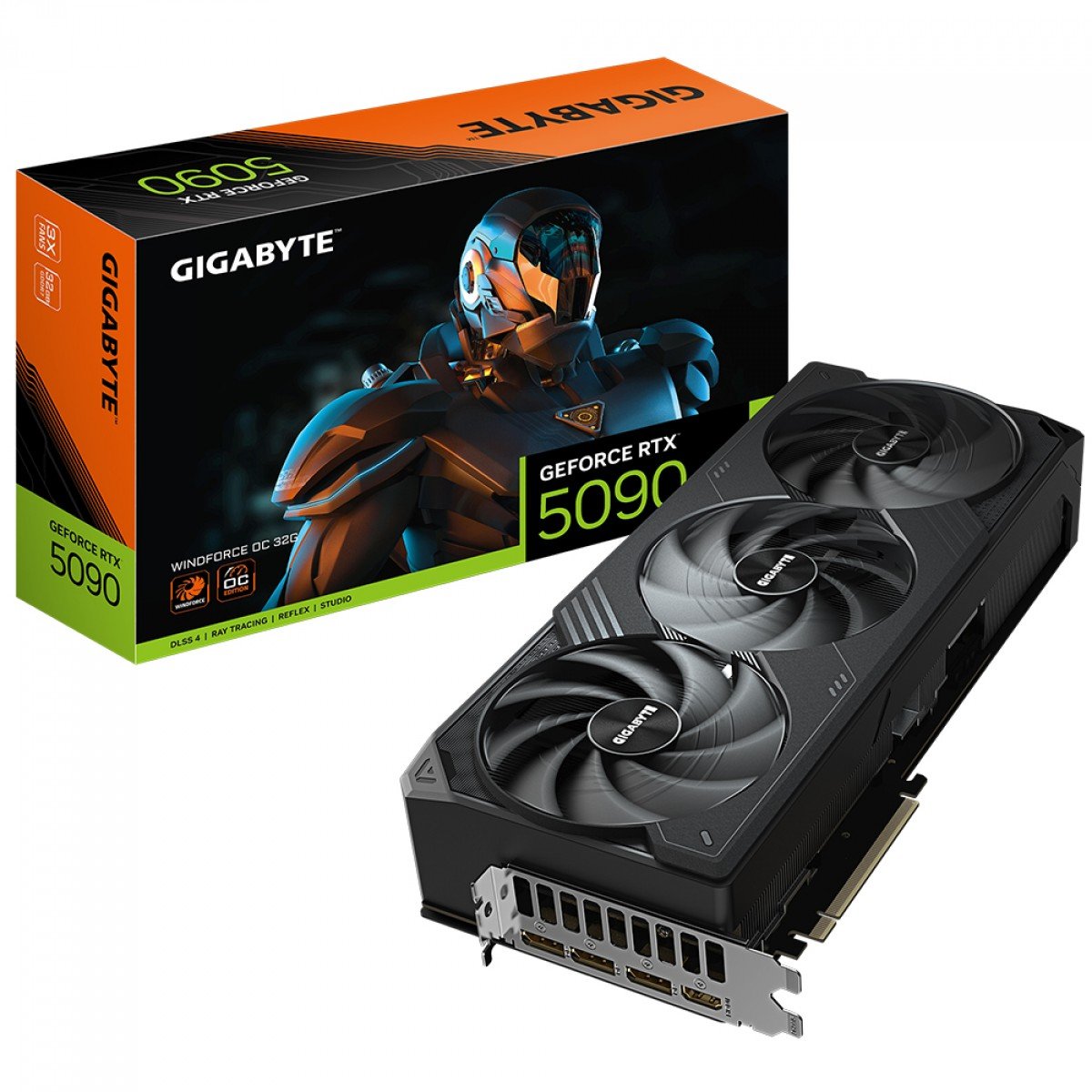
NVIDIA GeForce RTX 5090 Review: The Fastest Consumer GPU Ever Made
NVIDIA’s Blackwell architecture arrived in early 2026, and the RTX 5090 arrived at the top. The price tag – $1,999 for the Founders Edition – is not a typo. Neither is the performance. After two weeks of benchmarking across gaming, video rendering, machine learning inference, and 3D modeling, the RTX 5090 is the fastest consumer GPU available by a margin wide enough to matter. The question is whether that margin is worth twice the cost of an RTX 5080.
Architecture: Blackwell
Blackwell succeeds Ada Lovelace with a larger die, more CUDA cores, faster GDDR7 memory, and a significantly updated Tensor core architecture for AI operations. The RTX 5090 features 21,760 CUDA cores (up from 16,384 in the RTX 4090), 32GB GDDR7 on a 512-bit memory bus, and 1,792 GB/s memory bandwidth – a 79% increase over the RTX 4090’s 1,008 GB/s. The new 5th-generation Tensor cores enable Multi Frame Generation in DLSS 4, which generates up to three additional frames per rendered frame for a potential 4x framerate multiplier at compatible resolutions.
Specs at a Glance
| Specification | RTX 5090 | RTX 4090 (comparison) |
|---|---|---|
| CUDA Cores | 21,760 | 16,384 |
| VRAM | 32GB GDDR7 | 24GB GDDR6X |
| Memory bandwidth | 1,792 GB/s | 1,008 GB/s |
| TDP | 575W | 450W |
| DLSS | 4 (Multi Frame Gen) | 3.5 |
| Founders Edition price | $1,999 | $1,599 (launch) |
Gaming Performance: 4K
At 4K with settings maxed (no DLSS or Frame Generation): Cyberpunk 2077 averaged 87fps, up from 61fps on the RTX 4090 – a 43% improvement. Black Myth: Wukong at Ultra averaged 79fps. Alan Wake 2 with full path tracing averaged 52fps. These are rasterization numbers; they show a meaningful generational leap over Ada Lovelace.
With DLSS 4 and Multi Frame Generation enabled at 4K: Cyberpunk averaged 248fps, Black Myth 227fps. The visual quality of DLSS 4 at Quality preset is indistinguishable from native rendering at 4K in motion. The frames-per-second numbers are impressive, though frame latency (the delay between controller input and screen response) is not reduced proportionally by frame generation – competitive players should assess this trade-off before prioritizing generated framerates.
Creative Workloads
DaVinci Resolve 4K export with GPU-accelerated effects: 38% faster than RTX 4090. Stable Diffusion image generation (512×512, 50 steps): 18.4 images per second versus 11.2 on RTX 4090. Blender BMW benchmark: 47 seconds versus 78 seconds. These are substantial improvements for creative professionals who bought the previous generation and wondered whether upgrading would make a workflow difference. For video editors, 3D artists, and AI image generation enthusiasts who work at scale, it would.
Power Consumption
The 575W TDP is a significant increase from the RTX 4090’s 450W. Running the RTX 5090 at full load adds approximately $0.07-$0.10 per hour to electricity costs at US average rates. A gaming PC with an RTX 5090 under sustained load draws over 800W total. A 1000W or higher PSU is required; a 1200W unit is recommended for headroom. The Founders Edition uses the 16-pin (600W) connector – use the included adapter if your PSU lacks native 16-pin support.
Who Should Buy the RTX 5090
Enthusiast gamers who play at 4K and want the highest framerate possible. Creative professionals whose time is billable and a 40% reduction in render times translates to direct income gains. Machine learning researchers running local inference on large models – 32GB VRAM handles models that require multiple RTX 4090s to run otherwise. Early adopters who treat GPU flagship hardware as their primary discretionary purchase.
For a comparison with the more value-oriented flagship, read our RTX 5080 review. For AMD’s competing flagship, see our Radeon RX 9070 XT review.
Verdict
The RTX 5090 is the fastest consumer GPU available, and it is not close. Rasterization performance is 40%+ faster than RTX 4090. DLSS 4 with Multi Frame Generation delivers framerates that make 4K 240fps gaming achievable. The 32GB VRAM opens use cases that simply were not possible on 24GB cards. At $1,999 it is expensive in absolute terms. For the specific user who needs this level of performance, no alternative delivers it.
The RTX 5090 sets a new performance ceiling. Whether that ceiling is where you need to be depends entirely on your workload and your budget.