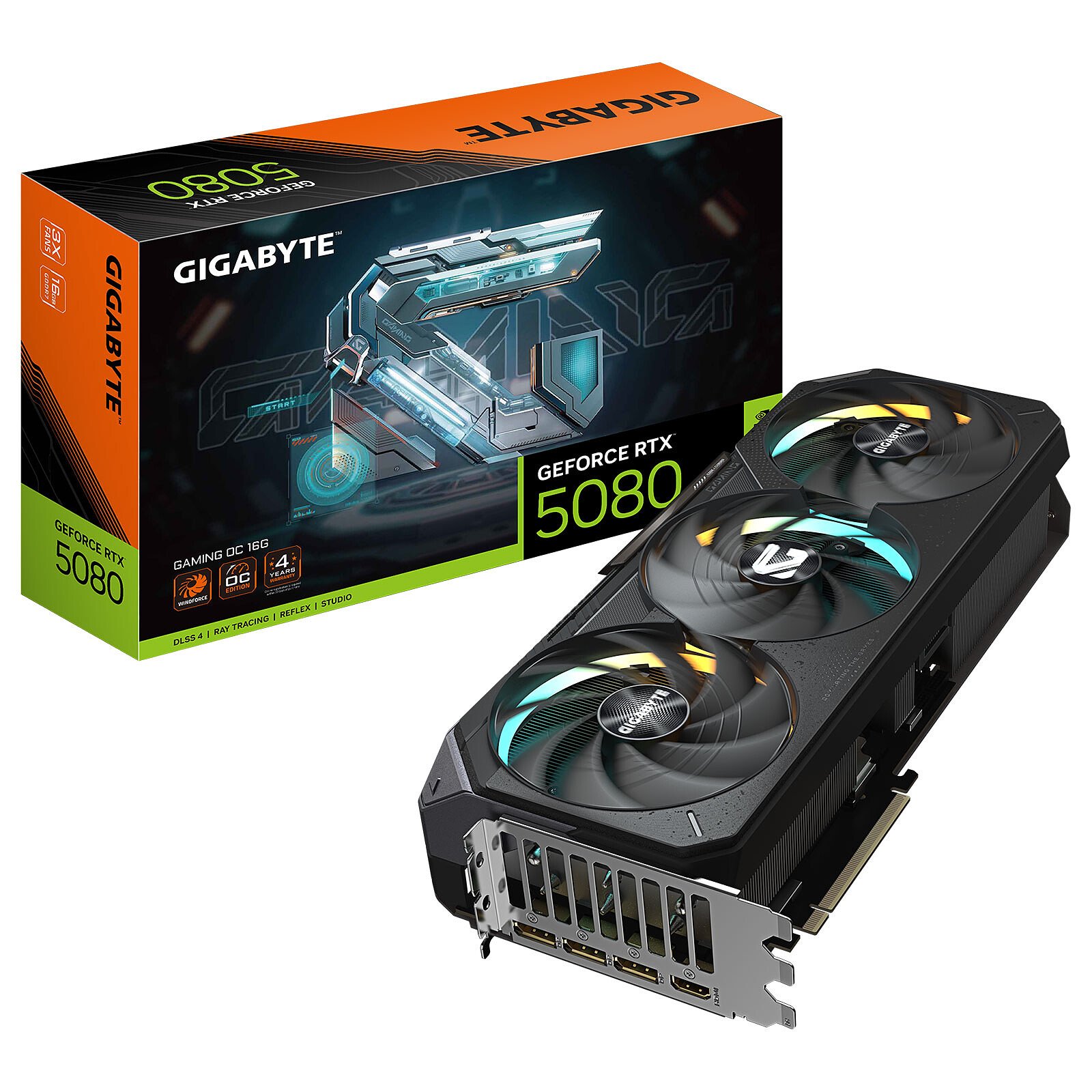
NVIDIA GeForce RTX 5080 Review: The Sweet Spot of the Blackwell Generation
The RTX 5080 sits $1,000 below the RTX 5090 and delivers approximately 70-75% of its performance in most workloads. Whether that gap justifies the price difference depends entirely on what you are trying to accomplish. After comprehensive benchmarking alongside both the RTX 5090 and the AMD RX 9070 XT, here is where the RTX 5080 fits in the 2026 GPU landscape.
Specifications
| Specification | RTX 5080 |
|---|---|
| CUDA Cores | 10,752 |
| VRAM | 16GB GDDR7 |
| Memory bandwidth | 960 GB/s |
| TDP | 360W |
| DLSS | 4 (Multi Frame Generation) |
| Founders Edition price | $999 |
4K Gaming Without Upscaling
At 4K with maximum settings and no upscaling: Cyberpunk 2077 averaged 79fps – strong enough for a smooth 4K experience at 60fps targets with headroom. Black Myth: Wukong at Ultra: 71fps. Alan Wake 2 with path tracing at 4K: 34fps – this title requires DLSS to be playable at 4K with full RT enabled. For most games without extreme ray tracing, the RTX 5080 handles 4K Ultra at 60fps comfortably.
4K Gaming With DLSS 4
With DLSS 4 Quality preset (1440p rendering output at 4K): Cyberpunk averaged 167fps. With Multi Frame Generation additionally enabled: Cyberpunk reached 312fps. The visual quality at DLSS Quality is practically indistinguishable from native 4K in motion. For 4K 144Hz gaming – the target for high-refresh 4K monitor owners – the RTX 5080 with DLSS 4 is the right GPU. It delivers sustained 144fps+ in virtually all titles with DLSS Quality enabled.
Ray Tracing
Ray tracing performance is a clear NVIDIA advantage versus the AMD RX 9070 XT. Alan Wake 2 with full path tracing at 4K (DLSS Balanced): RTX 5080 averaged 87fps versus the RX 9070 XT’s 52fps – a 67% NVIDIA advantage on this heavily RT-dependent title. On games with moderate RT use (one to two effects), the gap narrows to 15-25%. For gamers who prioritize RT-heavy titles, NVIDIA remains the platform of choice.
RTX 5080 vs RTX 5090: Is $1,000 Worth It?
The RTX 5090 costs $1,999; the RTX 5080 costs $999. The RTX 5090 is approximately 35% faster in rasterization and 40% faster with ray tracing at 4K. It has 32GB VRAM versus 16GB. For gaming at 4K with a 144Hz or 165Hz monitor using DLSS: the RTX 5080 with DLSS 4 delivers the same framerate as the RTX 5090 with native rendering – the additional RTX 5090 performance is used to generate frames that DLSS already generates. For 8K gaming or workstation ML tasks requiring 32GB VRAM: the RTX 5090 is irreplaceable. For most 4K gaming setups, the RTX 5080 at half the price is the rational choice.
RTX 5080 vs RX 9070 XT: Value vs Ecosystem
The RX 9070 XT at $649 versus the RTX 5080 at $999 – a $350 difference for 10-12% less rasterization performance and significantly less RT performance. For gamers who care primarily about rasterization and price-per-frame, the RX 9070 XT is the better value. For gamers who value the DLSS ecosystem, NVIDIA ray tracing performance, and CUDA for creative work, the RTX 5080 justifies its premium. See our full RX 9070 XT review for direct comparison data.
Verdict
The RTX 5080 is the best GPU for 4K 144Hz gaming in 2026 for users who want NVIDIA’s DLSS ecosystem and strong ray tracing performance without paying $1,999. It handles everything a 4K 144Hz gaming setup demands, delivers excellent creative application acceleration, and the 16GB GDDR7 VRAM handles current workloads without issue. The value case against the RX 9070 XT is real – pay $350 more for the NVIDIA ecosystem and RT performance advantage. For the right buyer, it is worth it.