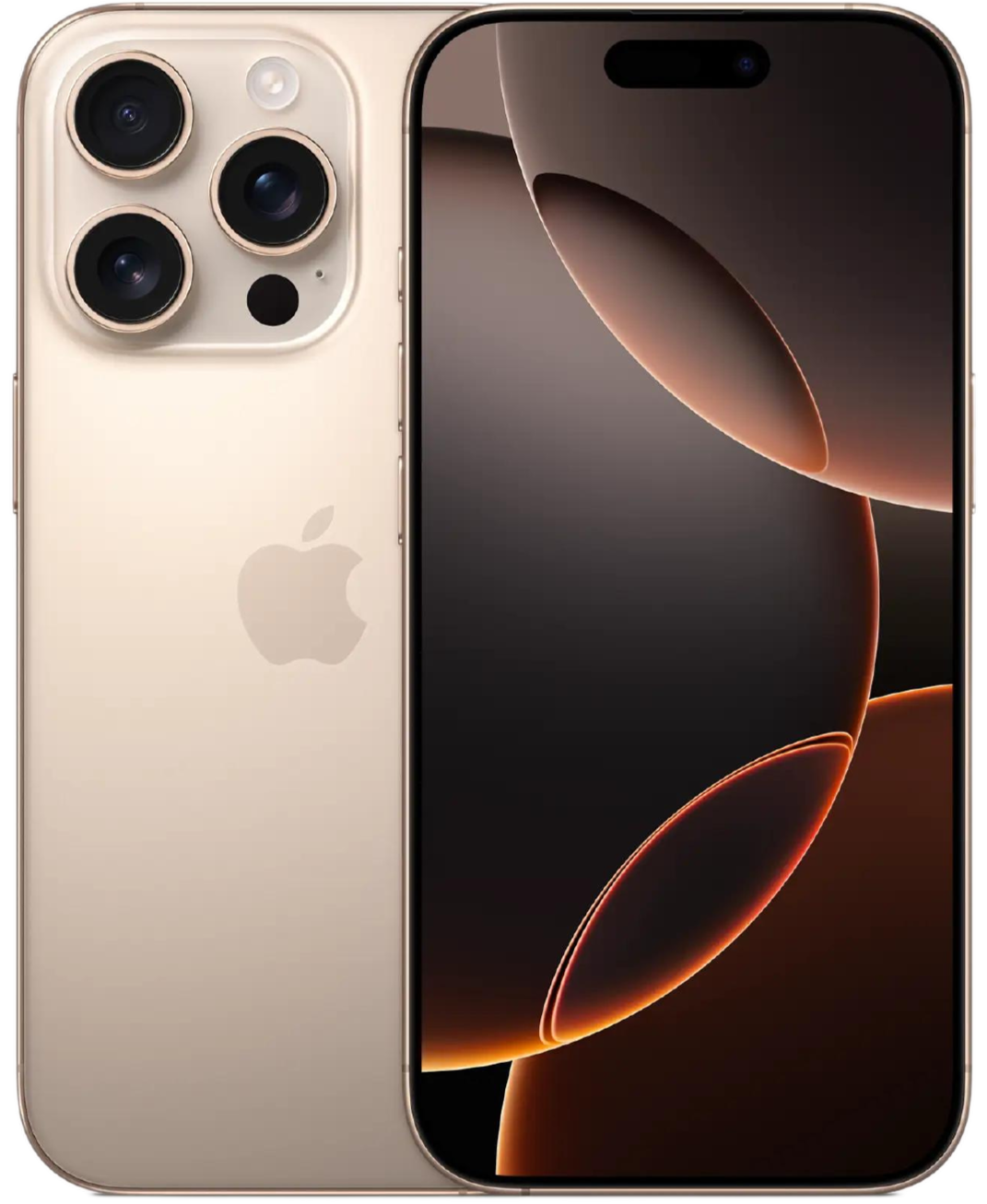
On the fourth day with the iPhone 16 Pro Max, I shot a 4K 120fps slow-motion clip of a car moving through a rain-slicked street and immediately opened it on the same screen. The detail in the water spray – individual drops hanging mid-air – was the first moment the camera system felt like a genuine step forward. Apple released the iPhone 16 Pro Max in September 2024, starting at $1,199 for 256GB. I tested the 256GB Natural Titanium model for six weeks. Last updated: May 2026.
The short version: this is the best iPhone Apple has made, and the gap between it and the previous generation is meaningful in two areas – camera and battery. If you are coming from an iPhone 14 or earlier, the jump will feel substantial. Coming from a 15 Pro Max, the upgrade is narrower but still real.
Verdict: 9/10. The 16 Pro Max earns its price through sustained battery life, a 5x telephoto that pulls its weight daily, and an A18 Pro chip that handles 4K 120fps without throttling. Three things to know before buying: the Camera Control button is only half-finished in software; the 30W charger is not in the box; and at 227 grams it is heavy enough to notice after an hour of one-handed reading.
Design
The iPhone 16 Pro Max measures 163 x 77.6 x 8.25mm and weighs 227 grams. Apple used Grade 5 titanium for the frame – the same alloy grade used in aerospace – which is harder and lighter than the stainless steel on the iPhone 14 Pro Max. The back is textured matte glass with a slight satin finish that resists fingerprints well enough for a full day without a case before smudges become distracting.
Four colours: Black Titanium, White Titanium, Natural Titanium, and Desert Titanium. The Desert Titanium is a warm beige-gold that photographs closer to gold than it looks in person. The Action button (introduced on iPhone 15 Pro) sits above the volume buttons and can be remapped to any shortcut. The new Camera Control button is a capacitive button on the right edge below the power button. It doubles as a dedicated shutter and allows lens selection by swiping – useful about 60% of the time, frustrating when the precise pressure it requires is not registered.
The USB-C port is now USB 3 speed (up to 10Gbps transfer), a meaningful upgrade over the USB 2 speeds on the standard iPhone 16. If you transfer 4K ProRes video to a Mac, the difference between 480Mbps and 10Gbps is roughly 20 minutes versus 90 seconds for a 10-minute clip.
Specs at a Glance
Spec
Detail
Display
6.9-inch Super Retina XDR OLED, 120Hz ProMotion, Always-On
Processor
Apple A18 Pro (3nm)
RAM
8GB
Storage options
256GB, 512GB, 1TB
Main camera
48MP, f/1.78, OIS
Ultrawide
48MP, f/2.2
Telephoto
12MP, 5x optical, f/2.8
Front camera
12MP TrueDepth, f/1.9
Battery
4,685mAh, 27W wired, 25W MagSafe
OS at launch
iOS 18
Dimensions
163 x 77.6 x 8.25mm
Weight
227g
Starting price
$1,199 (256GB)
Release date
September 2024
Display
The 6.9-inch Super Retina XDR panel runs at up to 120Hz via ProMotion and drops to 1Hz when the Always-On Display is showing the lock screen. Peak brightness reaches 2,000 nits in HDR content and 1,000 nits outdoors in typical use – readable in direct sunlight where phones without high-brightness screens require shade to be usable. The Always-On Display shows the time, widgets, and notification previews at a dim brightness that draws negligible battery.
Colour accuracy is Display P3 wide colour, which covers about 25% more of the visible spectrum than standard sRGB. For photographers editing on the phone, colours on screen are close to what a calibrated display shows. For everyone else, the screen simply looks vivid and accurate without being oversaturated the way some Samsung AMOLED panels look at default settings.
Performance
The A18 Pro is built on TSMC’s second-generation 3nm process. Geekbench 6 multi-core scores average around 8,500, ahead of the Snapdragon 8 Elite in the Samsung Galaxy S25 Ultra (roughly 7,800 multi-core). In daily use, the practical gap between these chips is narrow – both handle everything a modern phone demands without hesitation. Where the difference shows up is sustained load: after 20 minutes of GPU-intensive gaming at maximum settings, the 16 Pro Max stayed warm but not uncomfortable, and frame rates held without throttling.
The Neural Engine underpins Apple Intelligence, Apple’s suite of on-device AI features. All Apple Intelligence processing runs locally on the A18 Pro, which means no data leaves the device for features like Writing Tools, notification summarisation, and the improved Siri. The 8GB of RAM is consistent across the entire iPhone 16 lineup, so the Pro Max does not have a memory advantage over the base iPhone 16 in app retention.
Camera
Three cameras: 48MP main (f/1.78, OIS), 48MP ultrawide (f/2.2), and 12MP 5x telephoto (f/2.8). The main camera shoots 12MP by default using pixel binning, or full 48MP in ProRAW format. The 12MP processed files are almost always better-exposed and more immediately usable for social media and sharing. ProRAW is for photographers who want to control the raw file in Lightroom or Capture One.
The 5x telephoto is the standout. At 5x, subjects across a room or across a street are photographable with detail that holds up at full screen. Apple’s computational zoom produces clean results up to about 10x before obvious digital noise sets in. Below 10x, the quality is good enough that you will not feel the urge to crop in post. The ultrawide’s 48MP resolution (up from 12MP in previous generations) makes it genuinely useful for large prints or tight crops.
Low-light performance on the main camera handles dimly lit restaurant interiors without Night Mode activating. Night Mode kicks in automatically in darker conditions, and a one-second exposure consistently produces a clean, usable frame. Video: 4K at 120fps in slow motion requires the A18 Pro’s processing headroom. Log encoding is available for those who want to grade footage in post. Front camera is 12MP, shoots 4K at 60fps, and supports Cinematic mode.
Software
iOS 18 shipped on the 16 Pro Max. Apple Intelligence arrived in a phased rollout starting October 2024. Writing Tools (rewrite, proofread, summarise in any text field), Priority Notifications (surfaces genuinely urgent messages), and the improved Siri with awareness of your personal data earned their place. Image Playground generates low-resolution cartoonish outputs that feel experimental rather than useful. Clean Up in Photos removes objects from photos but leaves visible artefacts on complex backgrounds in most test shots.
iOS security updates are committed through at least 2030. The Control Center is more customisable than any previous iOS version, with separate pages and per-button layout control. The Dynamic Island, the pill-shaped cutout that shows active app states, remains one of the most practical uses of a notch-replacement that any phone has implemented.
Battery
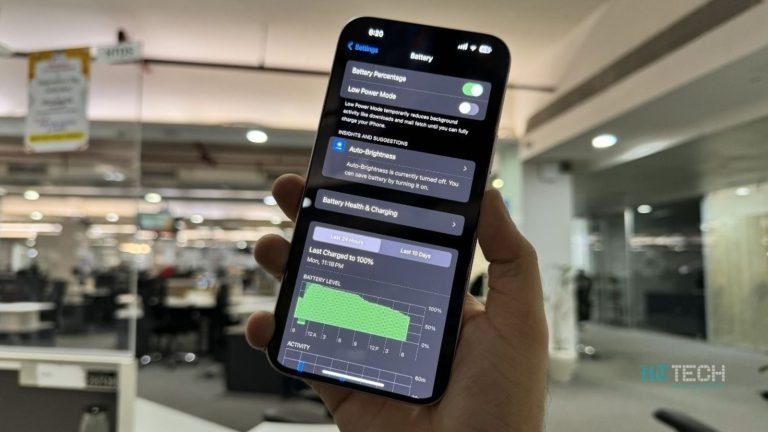
4,685mAh – the largest battery Apple has shipped in an iPhone. Over six weeks of testing under mixed daily use (email, social media, 45 minutes of navigation, an hour of video streaming per day), the 16 Pro Max delivered 12 to 14 hours of screen-on time consistently. Heavy days with extended camera use and GPU gaming pulled that down to 9 to 10 hours, which is still a full working day for most people.
Wired charging reaches 80% in 37 minutes using a third-party 30W USB-C charger. Apple’s included 20W adapter is slower; 30W is the sweet spot and not included in the box. MagSafe at 25W hits 80% in 59 minutes. Qi2 accessories charge at 15W.
Audio
Stereo speakers (bottom-firing and earpiece) are among the loudest on any phone at this size, usable for room audio at moderate volumes without distortion. Above 80% volume, the sound thins out and loses bass. No 3.5mm headphone jack – a USB-C to 3.5mm dongle is required for wired headphones (not included). Spatial audio with head tracking works via Bluetooth on AirPods Pro and AirPods Max.
Connectivity
5G with sub-6GHz and mmWave support (mmWave in US models only). Wi-Fi 7 – the first iPhone to support this standard, with theoretical speeds over 40Gbps on compatible routers. Bluetooth 5.3. Ultra Wideband chip for precise spatial awareness in AirDrop and Find My. Thread protocol support for smart home connectivity. Emergency SOS via satellite for areas with no cellular coverage, carried over from iPhone 14.
Price and Value
$1,199 for 256GB, $1,399 for 512GB, $1,599 for 1TB. The 256GB tier covers most users; 1TB is for video professionals. The Samsung Galaxy S25 Ultra starts at $1,299, the Google Pixel 9 Pro XL at $1,099. The $200 premium over the iPhone 16 Pro buys a larger screen, a meaningfully larger battery, and slightly better camera performance in video. Those differences justify the price for the right buyer.
Pros and Cons
Pros
Battery consistently delivers 12 to 14 hours mixed screen-on time
5x telephoto produces clean results up to 10x digital zoom
A18 Pro handles 4K 120fps without thermal throttling
USB 3 speeds via USB-C make ProRes transfers fast
Wi-Fi 7 and the most complete connectivity stack on any iPhone
Display P3 colour accuracy visible in everyday photo and video viewing
Cons
227g is heavy enough to feel after an hour of one-handed use
Camera Control button needs software refinement
30W charger not included in the box
Apple Intelligence image features still feel unfinished
Who It Is For
The 16 Pro Max is the right pick if you use your phone as a primary camera, shoot video regularly, or need the longest battery on offer. It is also worth the premium if you transfer large files between phone and Mac and need the USB 3 transfer speeds. Photographers who want ProRAW control and the full 48MP ultrawide will use those features daily.
Skip it if the 227g weight feels unwieldy or if you are coming from a 15 Pro Max and do not specifically need better battery or video. In that case, waiting for the iPhone 17 series makes more sense than paying the premium now.
Alternatives at This Price
Samsung Galaxy S25 Ultra ($1,299): Seven years of OS updates, 200MP main camera, built-in S Pen. Choose the S25 Ultra if the stylus matters to your workflow or if you are committed to Android.
Google Pixel 9 Pro XL ($1,099): Better computational photography AI in Google’s processing pipeline, 7-year update commitment, $100 cheaper. Loses to the 16 Pro Max on raw video quality and Apple ecosystem integration.
Frequently Asked Questions
Does the iPhone 16 Pro Max support MagSafe accessories? Yes. It supports the full MagSafe ecosystem at 25W wireless charging, and Qi2 accessories at 15W. Third-party MagSafe cases, wallets, and chargers all work.
Can the 16 Pro Max shoot ProRes video to internal storage? Yes. The 256GB model records ProRes at 4K 30fps internally. For 4K 60fps ProRes, you need 256GB or higher, and the files are large: roughly 6GB per minute of footage.
Does it support iOS 19? Yes. Apple has confirmed iOS 19 compatibility for the full iPhone 16 lineup, and the A18 Pro chip will support Apple Intelligence features through the update.
What is the difference between the 16 Pro and 16 Pro Max? Screen size (6.3-inch vs 6.9-inch), battery (roughly 3,600mAh vs 4,685mAh), and weight (199g vs 227g). The camera system is identical on both models.
The iPhone 13 Pro introduced ProMotion to the standard Pro size and macro photography to the iPhone lineup. At $350 to $450 used in 2026, it holds up surprisingly well.
The iPhone X launched at $999 in November 2017 and changed the iPhone’s face permanently. Eight years on, a look at what it got right and what the years have revealed.
The iPhone 15 brought USB-C, a 48MP main camera, and Dynamic Island to the standard lineup. In 2026 at $699, it is one of the best-value iPhones you can buy.
The iPhone 14 Pro introduced Dynamic Island, the 48MP camera, and Always-On Display. In 2026 at refurbished prices around $599, it is still a genuinely capable phone.