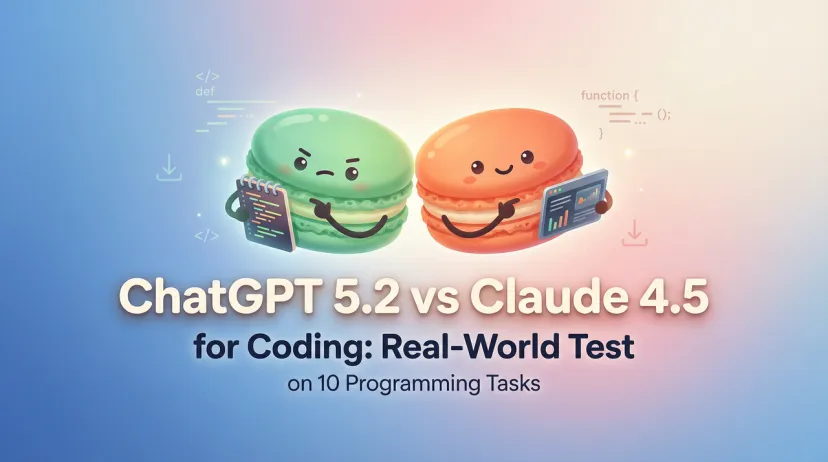
Claude vs ChatGPT for Coding: Which AI Writes Better Code?
Both Claude and ChatGPT claim to be excellent coding assistants, and both genuinely are. The differences between them are real but require specific scenarios to surface. I spent a month using both on a production Python FastAPI backend and a TypeScript React frontend, asking each the same questions, debugging the same errors, and generating the same components. Here is where they diverged.
Code Quality and Correctness
For standard CRUD operations, REST API endpoints, and common algorithmic problems, both produce correct, readable code at a high rate. Claude tends to write more defensive code – adding type hints in Python, null checks in TypeScript, and explicit error handling without being asked. ChatGPT writes slightly more concise code that requires fewer edits but occasionally skips error handling that a senior developer would include. Neither is wrong; it depends on whether you prefer verbose-but-safe or concise-and-clean as a default.
Explaining Existing Code
Claude gives better explanations of existing code. When I pasted a complex SQLAlchemy ORM query and asked what it does, Claude broke down each clause, explained the join strategy, identified a potential N+1 query issue I had not noticed, and suggested a more efficient alternative. ChatGPT explained what the query did correctly but missed the N+1 issue. For code review and understanding unfamiliar codebases, Claude’s explanations are more thorough.
Debugging Complex Errors
Error messages with obvious causes – missing imports, syntax errors, undefined variables – both handle instantly. The interesting test is subtle bugs: race conditions, off-by-one errors in async code, unexpected state mutations in React. On a real bug involving a FastAPI background task that was silently failing without raising an exception, Claude identified the root cause (an unhandled exception inside an asyncio task) in one response. ChatGPT suggested three things to check; the correct answer was the second one. Claude was faster here, but the margin was not large.
Long Context – Analyzing Large Files
Claude 3.7 Sonnet has a 200,000 token context window. GPT-4o has a 128,000 token context window. For most coding tasks this difference is academic – you rarely need to analyze 100,000 lines of code in a single conversation. But when it matters – analyzing a large codebase, reviewing an entire module at once, or maintaining context across a very long debugging session – Claude’s larger context is a real advantage.
Speed
ChatGPT responds faster on average, especially for short queries. For a one-line question, ChatGPT starts typing its response noticeably sooner. Claude’s responses are slightly slower to start but maintain consistent speed throughout. On longer outputs – generating a 200-line component – the total time is comparable. For interactive coding where you ask many short questions, ChatGPT’s lower latency adds up over a session.
Extended Thinking for Hard Problems
Claude 3.7 Sonnet’s extended thinking mode – where the model reasons step by step before writing code – produces noticeably better results on genuinely hard algorithmic problems. Dynamic programming challenges, complex concurrent systems design, and optimization problems where the naive solution is obviously wrong – Claude with extended thinking consistently produces more correct first-pass solutions than ChatGPT on these categories. For routine coding, this feature is overkill. For hard problems, it is worth the slower response time.
The Verdict
Claude edges out ChatGPT for code explanation, defensive coding style, large context analysis, and genuinely hard algorithmic problems. ChatGPT edges out Claude for response speed and concise-by-default output style. Both are excellent choices; the difference is most visible on complex debugging and code analysis tasks rather than everyday code generation.
If you work in an IDE and want AI coding directly in your editor, our GitHub Copilot vs Cursor comparison covers the two leading tools. For general AI assistant comparisons, see our ChatGPT vs Gemini breakdown.